Tuesday, June 26, 2012

The Importance of Eating REAL Food.

Recently, my friend Clarissa watched a movie called Forks Over Knives.  Immediately after watching it, she decided to cut out all processed foods and all animal products from her diet.  It was a shock to her how difficult it can be to locate unprocessed food in a modern supermarket.  She started asking questions on Facebook, asking people how to find whole foods and eat healthfully.  Her struggles in adapting to a whole food vegan diet started me thinking.
Eating whole foods is the foundation of good health.  No reputable diet book or researcher that I have ever heard of would dispute that simple fact.  But  despite the ease by which we can access an enormous variety of foods in modern times, our food selections have become more and more processed, even in the produce section.  Who buys a head of lettuce to make salad anymore?  We buy a pre-washed bag of salad which comes with ready-made toppings.   Do you want some fruit?  Here’s a pre-cut tray or a single-serving pack that will stay good for a week or two.  Food producers will process and package anything that they can get us to buy.
Clarissa’s movie isn't the only media that touches on this topic.  I recently viewed Food, Inc. which gives remarkable insights as to how the food industry operates.  Similar films abound:  Super-Size Me and Fat, Sick and Almost Dead are all good examples of this genre of expository film.  Add to that the plethora of literature which delves into deeper depths (The Omnivore’s Dilemma, In Defense of Food, The Face on Your Plate, and The End of Overeating) and it is very hard to deny that a radical change has taken place in our food supply over the last 30-50 years. 
One of the simplest things you can do to improve your health (and drop some weight) is to avoid processed foods.  What are processed foods?  How do you recognize a processed food?  It’s simple. 
Hallmarks of processed food:
·         It is usually packaged in a box, a can, a carton or a bottle. 
·         It has added ingredients (seasoning, sugar, vitamins, flavorings or artificial sweeteners.)
·         A natural ingredient has been removed (reduced-fat, low-carb, sugar-free.)
·         There are ingredients listed on the label that sound like gobblety-gook to a normal cook.
What is wrong with eating these things?   First of all, in the very act of processing the food, vitamins and minerals are lost.  Digestion-protecting fiber is lost.   Processed food often contains High Fructose Corn syrup (HFC), which is sweeter than sugar and damaging to your insulin sensitivity.  Processed foods rely on industrial farming, which uses genetically modified corn and soy products.  (Note: HFC’s are also made with genetically modified corn – something to consider before consuming.)   And processed foods are often higher calorie foods which deliver less nutrition and fullness than their whole food counterparts. They are also very frequently high in sodium, because salt helps accentuate flavors and make food tastier.
The End of Overeating made clear to me one of the biggest reasons to avoid processed foods.  Food scientists design their food, quite specifically, to reach as close to our “bliss point” as possible.  The “bliss point” is the point at which we derive the greatest pleasure from fat, sugar and salt.   They are designed to overcome our fullness receptors and make food become irresistible, despite the fact that we have already eaten enough.  Processed food is designed to manipulate us into eating more.
So we’ll skip the Hungry Man meal and go out to eat, right? Unfortunately, restaurant food is usually engineered, processed food, especially at chains.  If you chose to eat at a chain restaurant, whether it’s Denny’s, Chili's or The Cheesecake Factory, anticipate that most of what is served there is highly processed and may be even more intensely engineered toward your “bliss point.”  Chain restaurants value standardization; a burger or pasta dish in Tucson should taste exactly the same as one in Tuscaloosa.  Most of what is served is processed (pre-seasoned, injected with flavoring, etc.) to some degree or another.  And who wants to be engineered into eating more cheesecake?  (Don’t answer that.)  Smaller, local restaurants are more likely to make their food from scratch, but that doesn’t guarantee they do.  Ask before ordering, if you want to know.
So how do we avoid all the processing?  How do we eat without being manipulated by food scientists?
Focus on whole foods: foods as close to their natural state as possible.  Look for:
·         Unpackaged fruit and vegetables.
·         Dry grains (unprepared – no Minute Rice.)
·         Dry beans (soak and sprout them yourself; leave the gloppy canned stuff alone!)
·         Fresh, wild-caught fish (if available.)
·         Grass-fed beef.
·         Organic, pastured chicken and pork.
·         Pastured eggs (if you can find them) or free-range organic eggs.
·         Local, fresh, full-fat dairy.  If you can find a raw dairy supplier, that may be better yet.
·         If you’re not up to baking your own bread, then opt for the sprouted whole-grain versions.
Where do you find all this stuff?  That was Clarissa’s question.   If you’re lucky, you will find all of this at your local grocery store.  Be sure to check the health-food section and the bulk-food bins – they are a great place to find dry beans, raw nuts and whole grains with which to cook.)  But there are other sources:
1.      Local farmer’s markets and fruit stands.  These are a great way to eat fresh and local.  They connect you to your local farmers, and give you a chance to learn about them, what is in season and what is available locally. A big perk:  the produce is usually MUCH cheaper than a retail grocery store. 
2.      Join a co-op or a CSA.  These are usually membership or subscription driven groups, which provide organic, whole foods to members.  A CSA will usually offer a weekly box of fruits and vegetables, which is a fun way to eat well while trying out new produce.  In my experience, the absolute best fruits and veggies will come from a CSA.  A co-op will usually require some degree of participation from its members.  
3.      Find a local farmer for meat, dairy and eggs.  A great way to find local farmers is to check the website: www.slowfoodusa.org.  There you can locate your local chapter, which should be able to direct you to farmers who meet your needs.
4.      Okay, none of these work for meI have to shop at a regular grocery store like normal people.  There’s still hope!  If you’re lucky enough to have a Whole Foods nearby, I would suggest you shop there first – hands-down, they have the best variety.  Whole Foods is expensive, however.  Trader Joe’s often has good selections too, and it is less expensive, but nearly all of their produce is packaged in some manner. So in your Safeway, Kroeger or WalMart,  stick to the outside perimeter of the store and follow the below hierarchy of recommendations:

a.      Select organic whole foods first.
b.      Select non-organic, whole foods second.
c.       Select packaged whole foods over any processed foods.
d.      If you buy frozen, buy whole foods (i.e., not flavored with butter or pre-made meals.)

In all truth, in real life, we’re all going to eat some processed foods.  I’m not about to stop using my Worcestershire sauce or refuse the occasional hot dog to my son.  We eat at chain restaurants sometimes.  I want to live my life, not become a prisoner of food (healthy or otherwise).  But I do stay aware of the processed and manipulated foods I eat, and I try to be mindful of how much I consume.  Less is better.

Clarissa gave up the attempt at whole-food veganism after a week or two.  Even in that short time, she did lose weight, but she gained it back almost immediately after she reverted back to eating meat and processed foods.  The switch to exclusively whole-foods was a big change for her and very difficult to implement all at once.  I wouldn’t recommend this approach. 

Go incremental.  Make just one change at a time.  Chop up your fruits and veggies instead of buying the pre-cut.  Switch to whole-grains instead of the refined stuff.  Avoid foods with long lists of incomprehensible ingredients.  Drop HFC-products from your pantry.   Do it in whatever order best suits you, but every little counts towards making a big investment in your long-term health and wellness.   Make processed food the occasional meal, not the stuff of daily life.


If you are local to Solano County, these links may be useful:
(Note:  If you do chose to read The End of Overeating (I listened to the audiobook), be warned.  I GAINED weight listening to the book because he talked so extensively about food that I began to crave all the bad food choices he was talking about.  You may learn a great deal, but you may also battle your own processed food demons as a result.)


Sunday, June 10, 2012

Why Strength Training is Amazing and Why You Should Be Doing It


Walk into any gym, especially during those busy early morning or early evening hours, and you’ll see the cardio equipment in full use.  Every machine will be occupied.   Some gyms even have a sign-up sheet for treadmills during these hours, ensuring everyone has access.  And while this section of the gym is filled with people vying for their chance on a treadmill, the weight area has equipment available, sitting, unused, waiting for someone to come put it to use.
Is all this time on the treadmill really the best thing to be doing?  For fat loss?

No.  It is not.  Strength Training is.

Women overlook the dude-dominated weights area.  If they do strength training, they usually limit themselves to machines.   They don’t venture into the free weights area, except to maybe grab a 10 lb dumbbell once in a while.  The free weight area is where most women will get the greatest benefits, but women are literally afraid to go there.

What are they missing out on?  Why should any self-respecting, distance running or biking female wander into the testosterone zone?

1) Burn Fat and Raise Metabolism.  Strength training does not burn as many calories in a single session as does cardio, but it has fat-burning effects which make it even more important Namely, lifting weights to lose fat halts the loss of lean body mass (a proven side effect of weight loss due to diet alone or diet plus cardio) which is directly tied to your metabolism. Lean mass, which is composed of our bones, tendons, muscles, organs and everything NOT fat, is directly related to your metabolic rate. The more lean mass you have, the "faster" your metabolism.  Strength training increased your lean mass in two known ways:  increasing bone density and increasing muscle mass. Muscle burns about 7-10 calories per pound per day; fat burns 2-3 calories per pound per day.

Strength training studies repeatedly show gains in lean mass occurring simultaneously with fat loss.  The net effect is a leaner physique composed of less fat and more metabolism-boosting lean mass.

Cardio is good, but strength training is better.  Look at the following study, as described on exrx.com:    

Wayne Westcott, Ph.D. conducted a study in which 72 over weight individuals participated in an eight week exercise program. The participants were placed in two groups. The first group performed 30 minutes of endurance exercise on a stationary cycle. The second group performed only 15 minutes of exercise on the stationary cycle plus an additional 15 minutes on weight resistant exercises. At the conclusion of the study, the "endurance only" group lost a total of 3.5 lbs.; 3 lbs. of which was fat and a half pound was muscle loss. On the other hand, the "endurance and weight resistive" group lost 8 lbs. with an actual fat loss of 10 lbs. and an increase of 2 lbs. of lean body weight.

(8 week program, 72 over weight individuals)
Endurance Training (30 min)
Endurance (15 min) & Weight Training (15 min)
Weight Change (lbs)
-3.5
-8
Fat Change (lbs)
-3
-10
Lean mass Change (lbs)
-0.5
2

Westcott, W., Fitness Management. Nov., 1991.

Do you see the difference?  Greater total weight loss, greater total fat loss, AND in improvement in lean body mass.  The addition of strength training seriously RAMPS UP the fat loss results from exercise.  Cardio alone actually reduced lean mass, slowing metabolism. Who wants a slower metabolism?  

 Another study, reported in the Journal of American College Nutrition, also compared resistance training with aerobic training.  Both groups were placed on a very low 800-calorie/day diet.  At the end of the study, they found that the resistance training group lost significantly more fat (though the cardio group lost more total weight) and didn't lose any lean body mass (the cardio group lost a "significant" amount).  Moreover, the resting metabolic rate increased for the strength training group; it decreased for the cardio group. Like I said, who wants a slower metabolism?

Improving lean body mass and reducing fat is our goal, right? 

One very special aspect of Strength Training is its effect on Exercise-Post-Oxygen-Consumption (EPOC), also known as afterburn.  This is a super-cool effect that strength training has on our bodies, effectively raising metabolism for up to 48 hours after a workout.  48 Hours – that’s two entire days!  That means that, even when you’re sleeping after your workout, you’re still burning more calories than you would have otherwise.  The effect isn't gender-specific; a study published in the Journal of Sport Nutrition and Exercise Metabolism in 2000 showed that this effect hold true for women as well as men; intense resistance training produces a prolonged elevation of a post-exercise metabolic rate.

3)      Build the body you wantMost women have a fear of becoming big and bulky if they challenge themselves with weights.  The simple truth is that it is very hard to put on substantial muscle.   This is why men spend years in the gym and idolize Arnold Schwarzenegger (before he became a governor, anyway.)  It is very hard to achieve uber-hulky results without the use of steroids.  Women simply do not have the necessary amount of testosterone to build monster muscles.   

Strength training reshapes your body in a very good way.    Because a good strength training program will incorporate all major muscle groups, it is reasonable to expect the following results: 
  •  A flatter tummy.
  • Improved arm tone.
  • Broader looking shoulders (which help your purse and sundress straps to stay up and proportionally make hips look smaller.)
  • More shapely legs.
  • A rounder and lifted derriere.  No more pancake butt!
Keep in mind that a pound of muscle takes up less space than a pound of fat (about a third less.)  You can build muscle and still get smaller and more shapely while you do it. This is win-win-win!

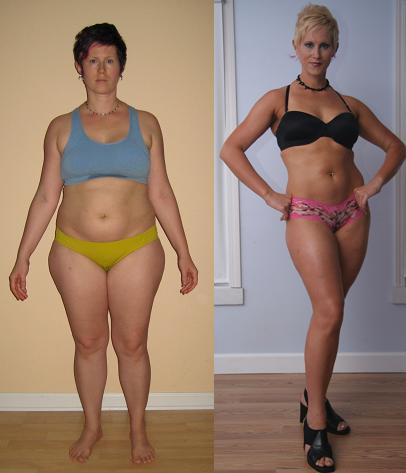
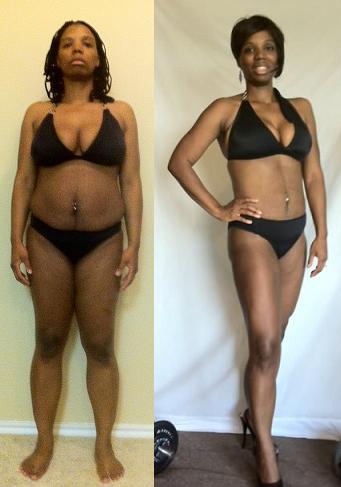
Still don’t believe me about not bulking up?  Here are some links to some before and after photos of people who strength train.   Are they big and bulky?  Which one of their pictures looks more like you want to look?


And here is a blog by a former National Bikini Competitor, aspiring powerlifter and fitness coach, Jen Comas Keck.  Everyone in this entry lifts weights, heavy ones – and are any of these girls big and bulky?  (The below pictures came from: http://www.jencomaskeck.com/2012/06/what-do-you-eat-peek-into-diets-of-some.html )

Jen Comas Keck


See what I mean?

4) Become motivated and empowered.  As you get stronger, you feel better about yourself.  As you track your progress in your workouts, every increase in what you can lift is a little win.  Those wins add up and keep you coming back. 

The positive changes in your body make you more confident in general and the strength gains make you more confident about what you can take on.  You can change the water bottle on the cooler at work.  You can carry the 50 lb bag of dog food without help.  You can do things that, once-upon-a-time, you thought you needed a man for.  

You begin to discover of what awesomeness you’re really made. You will find you can do things that you never imagined.

5) Prevent injury and disease.  Strength training help develop flexibility and mobility, making natural body movements easier.  In your daily life, you’re stronger and more capable, making injuries from daily life less likely.   It is documented and well known that, because of its ability to increase bone density, strength training will prevent and even reverse osteopenia, the precursor to osteoporosis.  And a study by the American Heart Association found strength training as an effective means to lower blood pressure.  

It's time to take back the weights area, ladies!  Now that you're ready to charge in and ignore the meatheads admiring themselves in the mirror as they do their bicep curls, what are you going to do when you get there?  You should have a plan.  At the end of this post, I have links to different books by experienced strength coachs; they're all good.  And if you're not yet convinced (or you like listening to the choir), check out the below articles from some awesome and beautiful badass women:


Suggested Programs:

And just to get you started, check out this blog post from Nia Shanks: http://www.niashanks.com/2011/12/11-beginner-strength-training-tips-women/

Happy Lifting!

Tuesday, June 5, 2012

The Dreaded Plateau

Every dieter has experienced it.  You know the story; despite doing everything right: working out and eating well consistently, the stubborn scale refuses to move.  You start to feel as if all this effort you are making is worthless and contemplate throwing your hands up in defeat and ordering that extra-large pizza you’ve been fantasizing about.   Not so fast!
There are tactics you can employ should this happen to you.  But before you start using them, be sure you really are in a plateau.
Take your measurements.  Before you order that pizza, get out your measuring tape.  You should have already taken your measurements when you initially began your fat loss journey.  If you don’t think you’re seeing progress now, the first thing you should do is measure yourself.  Why?  Because the scale doesn’t tell the whole story.  Sometimes, especially when you’re incorporating weight lifting into your workouts, you may still be getting smaller despite a stall on the scale.  In a nutshell, this can happen because you are gaining muscle at a close pace to that at which you are burning fat.  Muscles if famously more dense than fat (i.e., one pound of muscle takes up approximately 18% less space than a pound of fat), so you can still be growing smaller and losing fat, even if the scale doesn’t reflect it.  If you measure and find that you are still getting smaller, don’t sweat the scale number.  Your ultimate goal is to lose fat, right?  It isn’t to weigh less.  So congratulations!  You are losing inches and therefore becoming less fat.  Keep up the good work.
Okay, so you have measured and the tape isn’t showing any losses either.  What do you do now? 
1)      Check your water consumption.  
Are you drinking enough water?  Drinking plain water (not calorie-free beverages) has been shown to increase weight loss by up to 44% (in a  2008 study reported by the Journal of the American Dietetic Association.)  You may not experience the same considerable boost, but there are reasons why water can spur weight loss.  A study in 2004 found a metabolic increase of about 30% for its participants, theoretically from the thermal effort needed by your body to raise the cold water to body temperature.   Also a possibility is that just the consumption of water helps satiate your appetite, which often mistakes thirst for hunger.  And if you are retaining water from an overly salty diet or PMS, drinking extra water helps to instruct your cells to release the extra water, reducing your bloat and the water weight it causes. 
How much should you drink?  You should drink enough that your urine is clear or nearly colorless.  For most women, that requires about a 2 liter/day water intake.
2)      Eliminate breads, sugars and starches from your plate.
Nix the sugars and starches.  Yes, I said it.  If you’re stuck and not losing, I suggest you skip the bread at dinner.  Have a salad instead of a sandwich, or order the sandwich and eat it open-faced with a fork so you can avoid the bread.  Pass on the potato; opt for an extra helping of vegetables or fruit instead. 
“But starches are low calorie! Fat free!  Nutritional! They fill me up!”   There can be truth in that, but those objections are not the reasons I suggest eliminating them.  When ingested, starches convert to simple sugars, which provoke a fast insulin response.   One job of insulin is fat storage, so eating foods which provoke a high insulin response also turn on the fat-storage trigger in our metabolism.  Eating sugars and starchy foods tells our body to park any calories not immediately used in fat storage.  I don’t know about you, but if I’m trying to break through a plateau, the last thing I want to do is start up the fat storage engine. 
By cutting the starches and sugars, you minimize the hormonal response your body has to your food, which can translate into a big difference in fat loss.
3)      Try calorie cycling. 
Calorie cycling is a bodybuilder’s secret, but it is built into every program which includes a “cheat” day.  You may have done it without knowing it.  The theory behind this is that an occasional spike in calories helps avoid your body's adaptation to your low calorie diet.  The human body is very efficient, and if you feed it a lower calorie diet, it will adapt over time, reducing your losses.  Calorie cycling attempts to stymie its natural efficiency.
How to do it.  It is a fairly simple approach, with some no-nonsense caveats.  For 2-3 days a week, eat your normal, lower-calorie diet.  On the 4th day, eat more calories – around 500 calories more.  Do not eat crap.  Eat good food, just eat more of it or richer healthy foods.  Do not get comfortably having a weekly oreo and ice-cream binge.  That is not the idea.  Rather, you want to increase the total calorie count for the day.  On day 5, go back to your usual diet for a day or two and then repeat the higher calorie day on day 7.  Basically, every 2-3 days, add in a higher calorie day, then return to the usual menu.  I have also seen calorie cycling methods which go every third week instead of the third day.
4)      Change up your activity.
As mentioned above, the human body is very efficient.  It figures out how to accomplish what it needs using the least amount of energy possible.   If you have been following the same routine (endurance running and weight lifting, for example), change it.  Follow a different lifting program – try an upper/lower split instead of full body.  Bike instead of run.    Do sprints instead of a long run.  Try out the ergometer (aka, rowing machine) at the gym instead of the elliptic.  Mix it up. 
Add in HIIT and/or sprints.  High Intensity Interval Training (HIIT) and sprints both rely on a different energy system than longer, more endurance-type sports.  They also are huge fat-burners.  See my previous post for more info.
5)      Additional suggestions:

1)      Get more sleep.  Poor quality or quantity of sleep can affect your hormones, which in turn affects your fat metabolism.  If you are not already getting a solid’s night’s rest, make it a priority.
2)      Track and evaluate honestly what you are eating.  Are you really eating as well as you think you are?  Sometimes we slowly get off track and it doesn’t set off any alarms.  Look to see if you are eating 6-8 servings of fruit or vegetables.  Are you eating a lot of fast food?  Even “healthy” options at fast food restaurants usually have high sodium and sugar contents.   Are you snacking on something you’ve forgotten about?
3)      Tweak your macronutrients.  If you’re currently doing a 50/30/20, try a 40/35/25. Something different.  Play around with it.  You might find that you function better and lose more fat with a different macro composition. 
4)      Eat less salt.  In conjunction with drinking more water, you may find that dropping your salt intake can improve the scale’s behavior.  I do not suggest that water-weight is your ultimate goal, but water retention can hide legitimate fat losses. 

Most importantly, don’t give up!  Just because you’ve hit a roadblock doesn’t mean you need to turn around.  Keep up the good work and don’t be discouraged.  Try some of these suggestions. Find other suggestions (there are more out there, I’m sure.)  But keep at it; you’ll be glad you did!

Tuesday, May 1, 2012

Get your ZZZ's, please!

Sleep is one of the basic pillars of health.  We already know that our body repairs itself while we sleep, which is why we need so much extra sleep when we’re sick.  We know that sleep is needed for proper brain function; studies show that extended sleeplessness results in significantly deteriorated brain function compared to a rested brain.  But did you know that getting enough sleep is a major tool in your fat loss arsenal? 
The study results are overwhelmingly consistent.   Inadequate sleep has been proven to result in:
·         Increased fat loss for dieters, (Oct 2010) – This study placed 10 participates on a calorie-restricted diet and had one group sleep 8 ½ hours a night while the other only got 5 ½ hours.  Both groups lost weight, but the group with greater sleep lost 55% more weight from body fat than did the 5 ½ hour group. 
·          Increased consumption of calories (March 2012) - Specifically, an average of 549 extra calories was eaten per participant in the sleep-deprived group, who only slept 66% of their usual hours per night.
·         Increased desire for high fat, high calorie foods and increased intake of snack foods (Sept 2010) -  In a study on teenagers, teens who got less than 8 hours of sleep per night consumed a higher percentage of calories from fat, ate more snacks and took in a higher overall number of calories per day.

And that’s not all.  In a study just released today, in a sleep study of 1088 pairs of twins (604 identical, 484 fraternal), increased amounts of sleep were shown to help fight genetic predisposition towards weight gain.  The more sleep a twin got, the lower their BMI tended to be in comparison to the other twin.    And the less sleep a twin got, the higher their BMI.  The study found that higher quantities of sleep appear to counteract genetic tendencies towards weight gain.  For people who believe that they are just “born to be fat,” this is an important finding. 

Losing weight by sleeping more seems counter-intuitive.  After all, you don’t burn nearly as many calories while snoring away as you would if you were awake and active.  But the secret seems to lie in our bodies’ still-mysterious endocrine system, which regulates a number of poorly-understood hormones.   Sleep quantity and quality appear to affect certain hormones which play a role in appetite and fat metabolism: specifically, leptin and ghrelin.

·         Leptin is a hormone secreted by your fat cells, and it plays a roll in hunger and your metabolic thermostat.   Low levels of leptin increase the amount of hunger you feel.  High levels of leptin should decrease hunger and at one point researchers hoped to create a leptin pill that would reduce appetite.  Unfortunately, it appears that beyond a certain threshold, leptin resistance develops, lessening its ability to decrease hunger.   And because leptin is secreted by fat cells themselves, the very people who would hope to benefit from a “leptin pill” are the same people who have more than enough of it but have developed a resistance to its effects.
·         Ghrelin.  Ghrelin is a hormone secreted by your stomach which increases appetite.   An increase of ghrelin has been shown to make higher calorie food look more appealing than food choices under the same circumstances.    But ghrelin is also known to play a role in memory and growth, so any attempt to manipulate it may have undesirable side effects.

Sleep researchers are finding that sleep-deprived subjects experience increased levels of bad-food-choice-inducing ghrelin and increased leptin levels.   Put bluntly, a lack of sleep makes you want to eat worse food (and more of it) than you would have if you had gotten adequate sleep.  When it comes to sleep, more is better.  It means less overall calories eaten, improved leptin and ghrelin levels, and more energy the following morning. 

Few of us actually get enough sleep.  In fact, a new report by the Centers for Disease Control (CDC) found that more than 40 million workers get fewer than six hours of sleep each night. 


So how do you begin to get some extra ZZZ’s?
The National Sleep Foundation suggests the following to improve your sleep:
  • Set and stick to a sleep schedule. Go to bed and wake up at the same times each day.   
  • Expose yourself to bright light in the morning and avoid it at night. Exposure to bright morning light energizes us and prepares us for a productive day. Alternatively, dim your lights when it's close to bedtime. Additionally, you can use blackout curtains to darken you sleeping space, which purportedly improves the quality of your sleep.
  • Exercise regularly. Exercise in the morning can help you get the light exposure you need to set your biological clock. Avoid vigorous exercise close to bedtime if you are having problems sleeping.
  • Establish a relaxing bedtime routine. Allow enough time to wind down and relax before going to bed.
  • Create a cool, comfortable sleeping environment that is free of distractions. If you're finding that entertainment or work-related communications are creating anxiety, remove these distractions from your bedroom.
  • Treat your bed as your sanctuary from the stresses of the day. If you find yourself still lying awake after 20 minutes or so, get up and do something relaxing in dim light until you are sleepy.
  • Keep a "worry book" next to your bed. If you wake up because of worries, write them down with an action plan, and forget about them until morning.
  • Avoid caffeinated beverages, chocolate and tobacco at night.
  • Avoid large meals and beverages right before bedtime.
  • No nightcaps. Drinking alcohol before bed can rob you of deep sleep and can cause you to wake up too early.
  • Avoid medicines that delay or disrupt your sleep. If you have trouble sleeping, ask your doctor or pharmacist if your medications might be contributing to your sleep problem.
  • No late-afternoon or evening naps, unless you work nights. If you must nap, keep it under 45 minutes and before 3:00 pm.
If you are serious about losing fat, you need to get a good night’s sleep.  Sleep is integral to good health and researchers continue to find significant benefits. 

Additional reading: